Can a brain implant work without daily re-tuning?
- Half of same-day accuracy kept without re-tuning (likely 9–20)
- 14 days
- Half of same-day accuracy kept without re-tuning (likely 9–20)
- Memory per channel for the on-device version
- 12 B
- Memory per channel for the on-device version
- Of offline accuracy reached live, within a day
- 95%
- Of offline accuracy reached live, within a day
Result so far: a decoder trained on one day keeps at least half its accuracy for 14 days (likely range 9 to 20), against 0 days on the raw signal, and the fix needs 12 bytes of memory per channel. The earlier figures (52, then 25 days) came from fewer recording sessions. One animal, so read it as a first result.
A brain implant turns signals from the motor cortex into movement. In practice its decoder has to be re-tuned almost every day, because the signals drift. This page tracks one question: how long can a decoder keep working on its own, and what does it cost to run on a device? Each answer below is the current one and is rewritten in place when a new result changes it.
Data: one macaque, a 96-electrode array in motor cortex, decoding index-finger movement (the public LINK dataset). Q-05 uses 304 recording sessions over three and a half years; Q-01 to Q-04 use 30 days over 15 months. One animal, so read every answer as a first result, not a general law. Last updated 2026-11-20 · decoder spec v2 · code release v0.7.0.
Wide table: on a narrow screen, scroll sideways to see all columns.
| Question | Status | |
|---|---|---|
| Q-01 | Why does an implant's decoder stop working after a few days? | Answered |
| Q-02 | Can a simple fix keep it working without re-tuning? | Answered, partly |
| Q-03 | Can that fix run live on a device? | Answered |
| Q-04 | Does a bigger AI model solve it? | Dead end (this design) |
| Q-05 | How many days can it go with no re-tuning at all? | Answered (baseline) |
| Q-06 | Can it recover after months without new labelled data? | Open |
Q-01 · Why does an implant's decoder stop working after a few days?
Status: Answered. Each electrode's signal drifts: its overall strength rises and falls from day to day, and the strongest channels lose the most over months. A decoder learned on the first day keeps reading the old pattern. Tested on 29 later days, it did worse than simply guessing the average movement on 27 of them. The movement information is still there; the decoder just no longer matches how it is encoded.
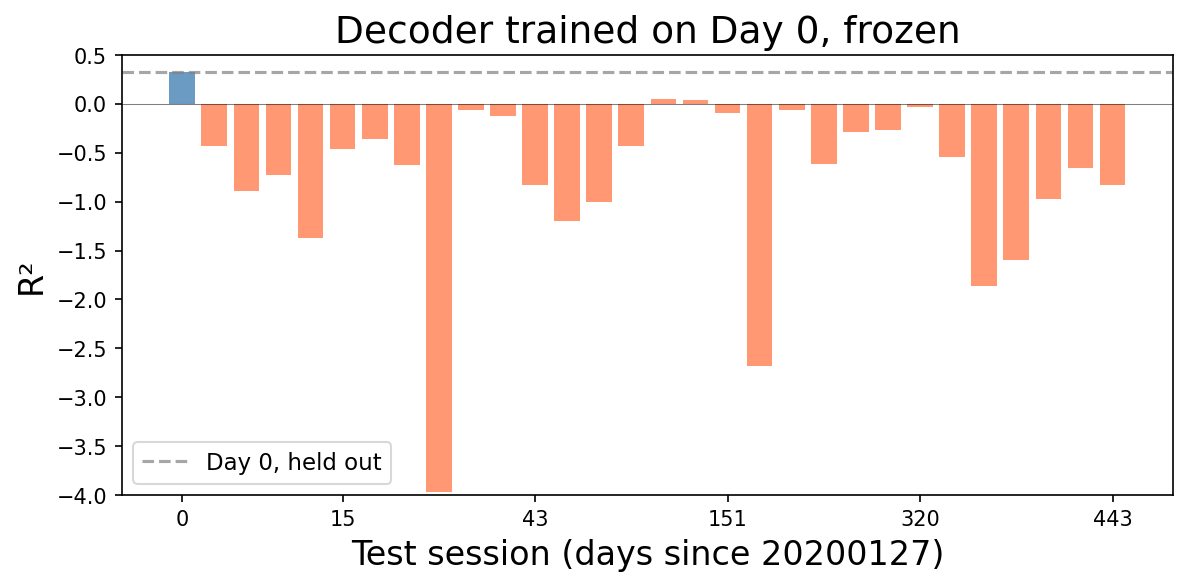
A decoder trained on day 0, tested on every later day. Bars below zero mean worse than guessing the average movement.
Numbers and method
Wide table: on a narrow screen, scroll sideways to see all columns.
| Quantity | Value |
|---|---|
| Day-0 decoder, same day (held-out blocks), R² | 0.32 |
| Later days with R² below zero | 27 of 29 |
| Median R², days 8–30 / beyond 30 | −0.73 / −0.55 |
| Lowest | −3.97 on day 29 |
Ridge decoder on spike-band power (300–1000 Hz) over the last 100 ms, predicting finger velocity at the current 20 ms bin. Day 0 is the first recorded session (about day 349 after implant). Full write-up: The signal that won't stay still.
Q-02 · Can a simple fix keep it working without re-tuning?
Status: Answered, partly. Rescaling every channel within each day removes the big failures: average accuracy on a new day goes from far worse than guessing to about break-even. A day-one decoder still keeps about half its accuracy three days later. Beyond a month it carries nothing over. The extra smoothing step I added makes it slightly worse, so the rescaling alone is the fix.
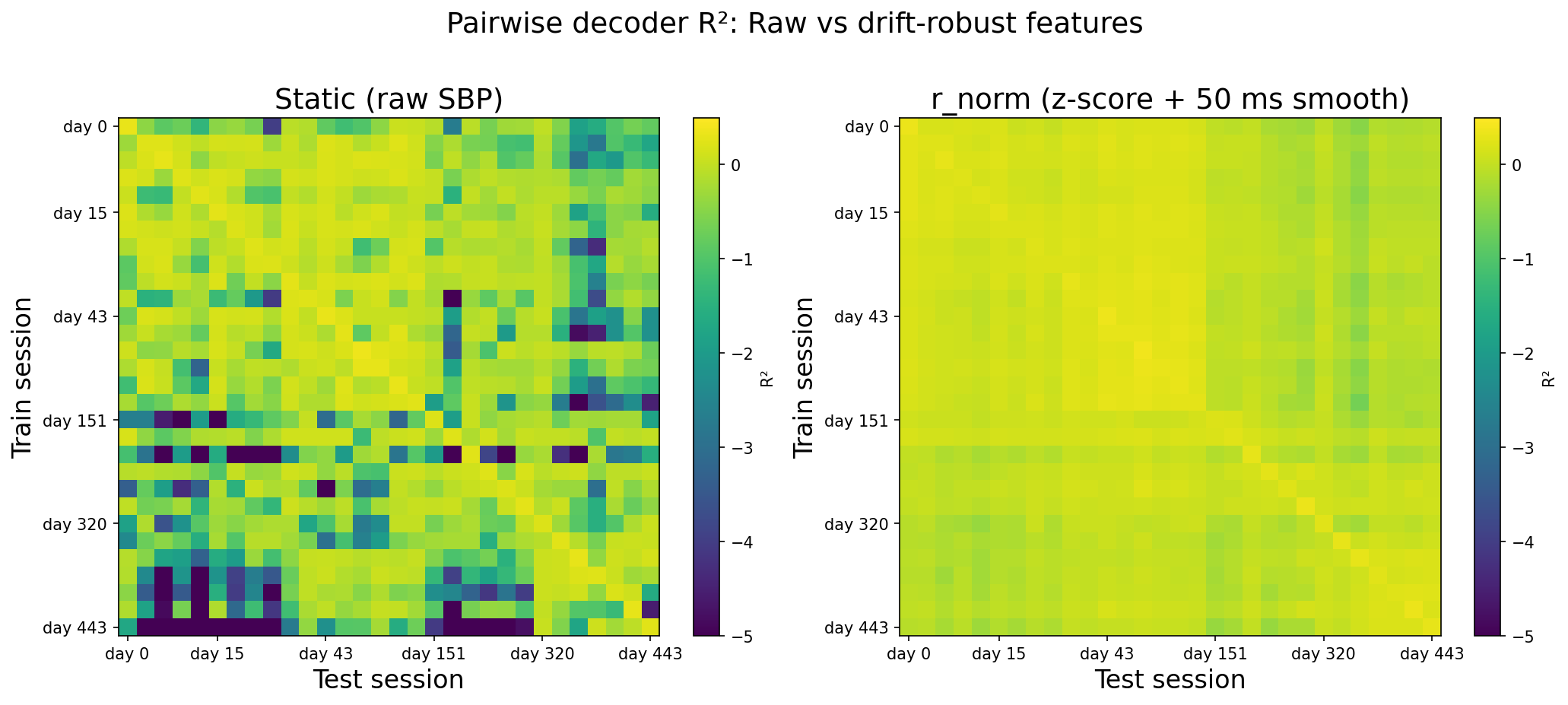
Every train-day / test-day pair. Left: raw signals, many deep failures (dark). Right: rescaled within each day, close to zero almost everywhere.
Numbers and method
Wide table: on a narrow screen, scroll sideways to see all columns.
| Quantity (mean over 870 day pairs) | Value [95 % CI] |
|---|---|
| Raw signal | −0.907 [−1.381, −0.524] |
| Rescaled (z-score only) | +0.051 [+0.014, +0.095] |
| Rescaled + 50 ms smoothing (r_norm) | +0.030 [−0.012, +0.079] |
| Gain from rescaling | +0.937 [+0.576, +1.399] |
| Effect of smoothing | −0.021 [−0.028, −0.014] |
| Day-0 decoder: same day / day 3 / 30+ days | 0.341 / 0.166 / −0.041 [−0.122, +0.037] |
CIs resample recording days (2,000 draws). The numbers come from a script that writes its own report (results/analyses/drift_fix.md in the code). On the dataset authors' own train/test split, this decoder matches their ridge baseline (0.252 vs 0.246). Full write-up: The fix is simpler than you think.
Q-03 · Can that fix run live on a device?
Status: Answered. Yes. A version that only looks at past data, which is all a device has, works as well as the offline one: within a day it reaches 95 % of the offline accuracy, and it carries over between days slightly better. Rewritten in whole-number arithmetic, as a small chip would run it, it needs 12 bytes of memory per channel (target: 16) and loses no accuracy. Adapting more slowly, or carrying over from earlier days, made it worse.
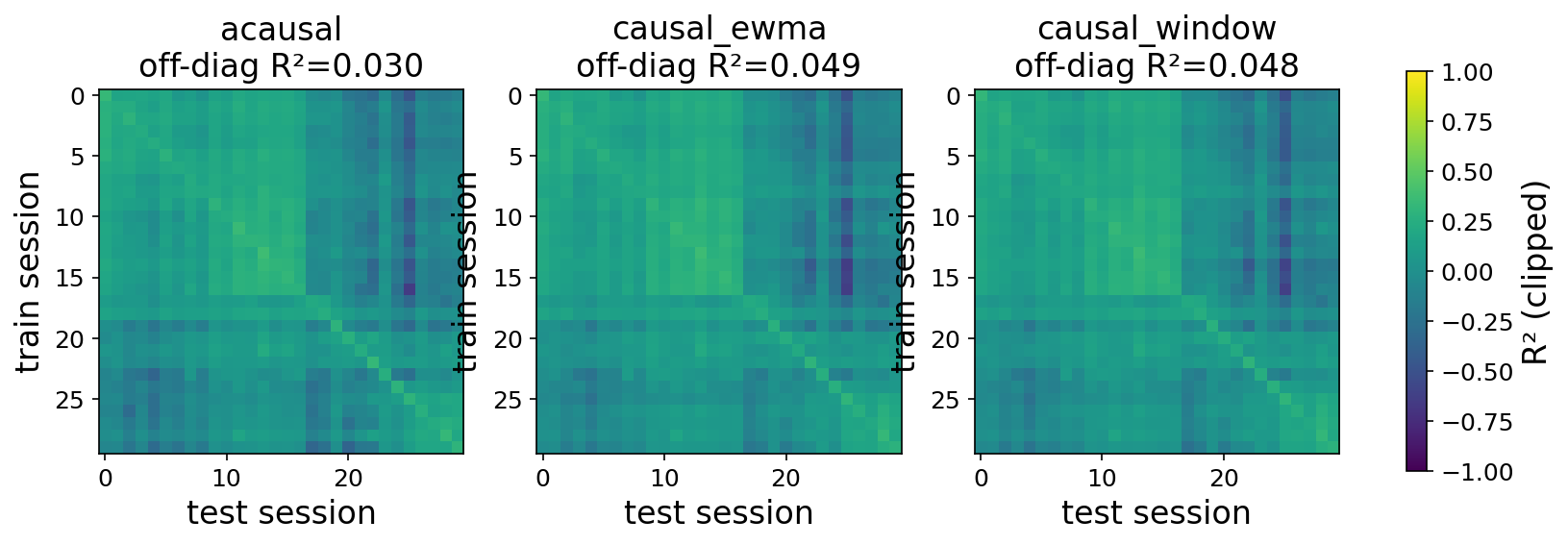
Offline rescaling (left) against two live versions that use only past data. The live versions are slightly better on average.
Numbers and method
Wide table: on a narrow screen, scroll sideways to see all columns.
| Quantity | Value [95 % CI] |
|---|---|
| Same-day R², live vs offline (median of 30 days) | 0.263 vs 0.276 |
| Day-pair mean, live − offline | +0.019 [+0.011, +0.027] |
| Memory per channel: 32-bit integers / float64 | 12 / 24 bytes (target 16 or less) |
| Integer − float version, same-day R² | +3.0 × 10⁻⁷ [−1.3 × 10⁻⁷, +7.2 × 10⁻⁷] |
| Operations per 20 ms bin, rescaling + decoder, 1024 channels | 45,056 with hardware square root and divide; 275,456 without (budget 100,000) |
| Day-pair R², 30-minute time constant carried across days vs 2 s reset (17 earliest days) | −0.294 vs +0.194 |
Live version: exponential running mean and variance (rate 0.01, a 2-second time constant, reset each day; slower settings and carrying state across days were tried on the 17 earliest days and lost) plus a one-pole smoother. The integer version is 32-bit fixed point, checked against the float version on all 30 days; operations are counted by the code as it runs, not cycles. The earlier "cost of causality" came from a decoder that predicted 60 ms ahead. Full write-up: The fix that can't ship.
Q-04 · Does a bigger AI model solve it?
Status: Dead end (this design). Not this one. A neural network trained on two months of recordings did worse on the following months than a straight-line model given the same inputs, and worse than guessing on 11 or more of 13 later days. Its earlier good score came from testing it on days it had already seen. Compressing the inputs too hard threw away most of the movement signal.
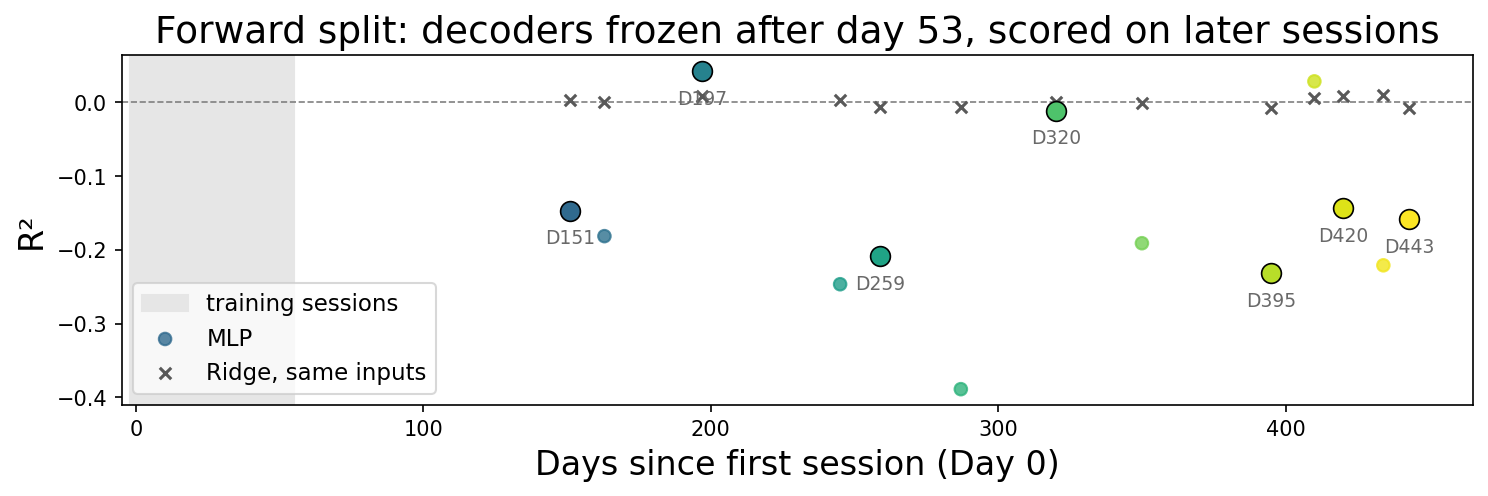
Trained on days 0–53 (shaded), tested on days 151–443. Circles: neural network. Crosses: linear model on the same inputs.
Numbers and method
Wide table: on a narrow screen, scroll sideways to see all columns.
| Quantity (13 later days, 3 seeds) | Value [95 % CI] |
|---|---|
| Neural network, held out | −0.152 |
| Same network scored on its training days | +0.141 |
| Network − linear model, same inputs | −0.153 [−0.204, −0.097] |
Inputs: 5 principal components of 192 channels, 400 ms of history. A tuned network on the full inputs would be a new experiment. Full write-up: A cross-session MLP, scored on held-out sessions.
Q-05 · How many days can it go with no re-tuning at all?
Status: Answered (baseline). About two weeks. A decoder frozen on one day, with the live-ready rescaling, keeps at least half of its same-day accuracy for 14 days (likely range 9 to 20) across 304 recording sessions. On the raw signal it is zero days. My earlier explanation, that early-2020 recordings made the longer figures, did not hold on the full data. Decoders tested on the same of the task's two target styles carry over better; that is a lead, not yet tested.
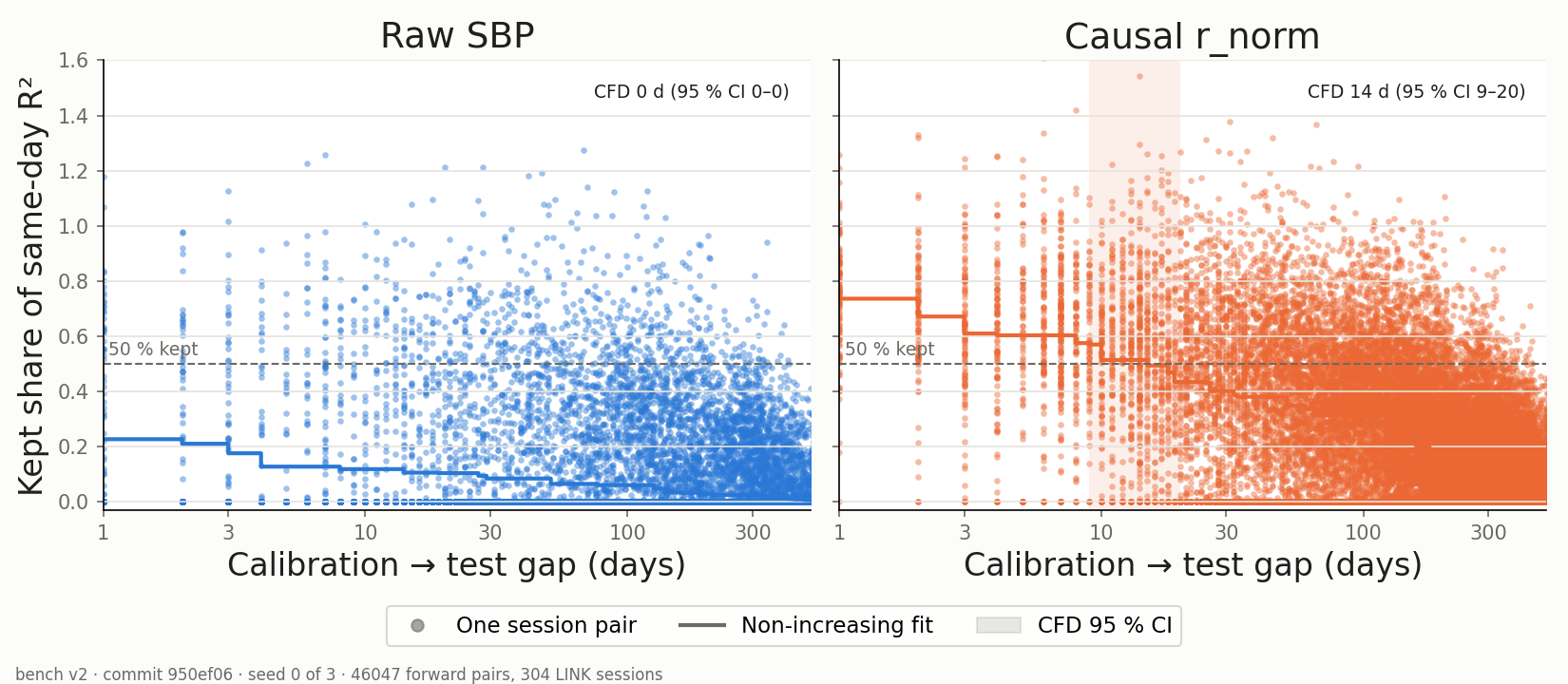
Share of same-day accuracy kept, against days between calibration and test. The shaded band is the likely range of the crossing point.
Numbers and method
Wide table: on a narrow screen, scroll sideways to see all columns.
| Quantity | Value [95 % CI] |
|---|---|
| Calibration-free days, live rescaling | 14 [9, 20] |
| … decoders set up in 2021–2023 only | 14 [8, 18] |
| Calibration-free days, raw signal | 0 [0, 0] |
| Share kept 1–7 days apart, set up in 2020 minus 2021–2023 | +0.16 [−0.05, +0.23] |
| Share kept 8–30 days apart, same | +0.14 [−0.02, +0.31] |
| Share kept 31–52 days apart, same | +0.05 [−0.20, +0.28] |
| Same, within one target style, 8–30 days | +0.06 [−0.06, +0.21] |
| Share kept, same minus different target style, 1–7 days | +0.18 [+0.11, +0.24] |
| … 8–30 days | +0.14 [+0.08, +0.20] |
| … 31–52 days | +0.12 [+0.03, +0.21] |
| Previous estimates, 74 and 30 recording sessions | 25 [11, 52] · 52 [42, 82] |
46,047 forward pairs over 304 recording sessions (2020-01-27 → 2023-06-22; quality checks dropped 8 of 312), non-increasing fit, 50 % threshold; 3 seeds; the CI resamples sessions. The predictions were written before the run, and by that rule the recording-period question is inconclusive. The target-style difference was measured but not predicted, so it needs its own test. The recording year cannot separate the recording period from the implant's age. Decoder cost: 576 multiply-accumulates per 20 ms bin. Source: the public scoreboard.
Q-06 · Can it recover after months without new labelled data?
Status: Open. Beyond a month nothing tried so far carries over. The next step is to line up each new day's signals with the first day's using only the signals themselves, no recorded movements, and test whether month-old decoders come back. This is the next milestone; a negative result will be reported here too.
Plan
Three methods in order of complexity: Procrustes alignment, factor-analysis alignment (Degenhart et al. 2020), then a small NoMAD-style model. All must run with past data only. Pass: month-plus R² of 0.15 or more, or a documented negative.
What I got wrong
- Scored the day-0 decoder on its own training data, which made day 0 look better (0.299 instead of about 0.26 at the time).
- Reported a neural network as working for 443 days; it had been tested on days it trained on.
- Numbers in two write-ups came from an older, different run.
- Called a "1–7 days" result what was really days 3–28, and called day 0 the implant day.
- Reported a cost for running live that came from a decoder predicting 60 ms ahead.
- Stated the wrong frequency band for the main signal (300–3000 Hz; it is 300–1000 Hz).
- Said the longer early estimates came mostly from recordings in early 2020; on all the data that does not hold.
Changelog
- 2026-11-20 · Q-05: 14 days on 304 recording sessions, not 25; the early-2020 explanation did not hold on the full data.
- 2026-11-16 · Q-05: 25 days on 74 recording days, not 52; the earlier figure came mostly from recordings in early 2020.
- 2026-11-07 · Q-03: the integer version needs 12 bytes per channel and loses no accuracy; operation counts for a device; slower or carried-over rescaling does worse.
- 2026-10-25 · This page replaces the four-part series. Answers written on decoder spec v2 with 95 % CIs.
Code: github.com/radhakrishnanrishaban/ephys-signal-atlas · release v0.7.0